Barracuda, ARTEX, and the Key Nobody Killed
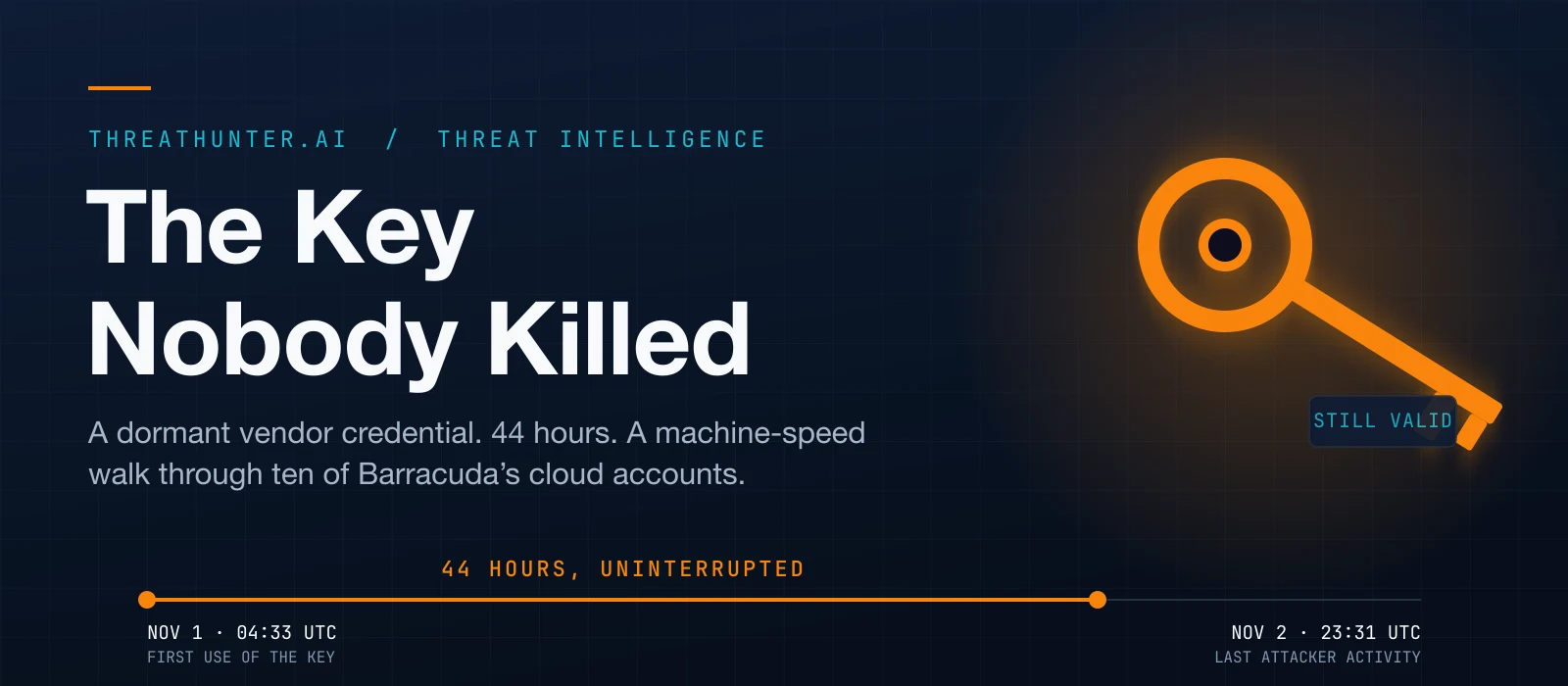
Barracuda got breached this month, and nobody had to hack anything to get in. The attacker logged in with a valid cloud access key. Barracuda had issued that key to a vendor for a project. The project ended. The key didn’t.
Then the vendor got popped, the key walked out the door, and something that looks a whole lot like ARTEX spent 44 hours working its way through about 10 of Barracuda’s cloud accounts.
I’m not writing this to dunk on Barracuda. Their CISO, Arve Kjoelen, put the root cause in writing with four words most legal departments would never let out of the building: “That is on us.” Respect. I’m writing this because every one of us has that key sitting somewhere, and the thing that finds it no longer needs sleep.
What actually happened
Everything here comes from Barracuda’s own security notice and technical write-up. I’m sticking to what they published.
- Barracuda gave a third-party vendor, an AI company, a cloud access key for a project.
- The project wrapped up. Nobody retired the key.
- In early October, the vendor’s development environment was compromised. The key was sitting in a configuration file in the vendor’s GitHub repository.
- Other Barracuda credentials in that same file had already expired or been revoked. This one still worked.
- On November 1, somebody used it.
No zero day. No phishing. No exploit chain with a clever name and a logo. A key that should have been dead opened the front door.
One note on attribution, because the internet will not be careful about this. Barracuda has not named a threat actor. What they say is that the method matches ARTEX: machine-generated resource names, the order of operations, and the built-in routines for hunting credentials and crypto wallets. That identifies the tool. It does not identify who was driving it.
Forty-four hours
| When (UTC) | What happened |
|---|---|
| Early October | Vendor’s development environment is compromised. The key goes with it. |
| Nov 1, 04:33 | First use of the key. Within minutes the attacker maps what it can reach and reads stored secrets, including AWS access keys and Azure service principal secrets. |
| Nov 1 into Nov 2 | Each secret opens the next system: cloud accounts, the data analytics environment, a source-code access token, Kubernetes clusters. |
| Nov 2, early hours | Short-lived branches get pushed to several repos to trigger build workflows that dump build-system secrets into the job logs, encoded to slip past secret masking. |
| Nov 2, 23:31 | Last recorded attacker activity. |
| Nov 4 | An engineer notices odd activity on their own account and reports it. The vendor calls the same day. Barracuda traces the chain and pulls the persistence container that evening. |
| Nov 10 | Public advisory. Updated Nov 13 with the root cause. |
Look at the two dates that matter. The attacker was done on November 2. Barracuda found out on November 4. Nobody interrupted this intrusion. It finished and left.
What was it after? Credentials, everywhere it could find them: secret stores, infrastructure-as-code state files, server metadata services, Kubernetes service accounts. And cryptocurrency. It went looking for wallet variables, Ethereum keystores, and seed phrases. There weren’t any. Barracuda reads the wallet hunting as a financially motivated actor.
It also tried to stay. It dropped a container in a Kubernetes cluster that mounted the host’s file system, and it tried to create a new admin cloud identity. That second one got blocked.
Here’s the part that matters if you’re a customer. One of the systems it reached stores the credentials Barracuda XDR uses to pull data from customer environments like Microsoft 365 and Google Workspace. Barracuda found no direct evidence those were touched. They also said the logging in that environment wasn’t detailed enough to rule it out. So they did the right thing and told the potentially affected customers to revoke and recreate their integration credentials.
Old failure, new clock
A vendor credential that outlives the engagement is not a new finding. It has been on audit reports for as long as I’ve been doing this. So has a secret sitting in a config file in a repo. ARTEX didn’t invent a single attack here.
What changed is what that mistake costs.
A few years ago, a leaked key sat in somebody’s dump until a human got around to it. They tried it. They poked around. They went to lunch. They came back and tried the next thing. That lag was our margin, and most of us never knew we were living on it.
Now a planner agent hands that key to a crew of workers. The workers map what it reaches, read every secret they can touch, and report back. Every credential becomes a new lead, and every lead gets a worker. Nobody goes to lunch. Barracuda’s numbers say minutes from first use to stored secrets, and five platforms in under two days.
I know what this looks like from the other side, because I built it. I spent a weekend standing up ARTEX in a 10-inch rack on my own hardware and pointing it at environments I own. It’s noisy and trigger happy out of the box. Prompted properly, it’s cunning. And I’m one sleep-deprived CEO with a long weekend. The people doing this for money have more compute, more people, and more patience than I do.
Barracuda’s conclusion is that detect and respond can’t be the primary strategy against machine-speed attacks, and that prevention and recovery have to come first. I agree with half of that.
Prevention first, yes. Kill that key the day the project ends and this blog post doesn’t exist.
But don’t let detection off the hook. A vendor key from a finished project that wakes up at 04:33 UTC and starts reading secret stores is not subtle. That’s behavior, and behavior is the one thing the agent can’t easily fake. Speed makes the window small. It doesn’t make it zero. You close it by hunting on what a credential does, not by waiting for an engineer to notice something weird two days later.
One more thing, for my fellow security vendors. We are the target now. We hold the keys to our customers’ environments, which makes our credential stores worth more than almost anything else we own. I run a company that holds those keys too, so I’m not throwing rocks. I’m checking my own house.
What I’d do this week
None of this is exotic. That’s the point.
- Inventory every credential you’ve handed to a third party. Vendors, contractors, integrators, that AI startup from the pilot last spring. Find the ones whose project is over and kill them today.
- Put an expiration on everything. Short-lived and narrowly scoped. Barracuda says it plainly: that alone would have stopped this at step one.
- Offboard vendors like you offboard employees. End of engagement means end of access. Make it somebody’s job, with a name on it.
- Ask your vendors where your keys live. If the answer is a config file in a repo, you have your answer.
- Break the chain. No single credential should unlock the next system. Go look at what’s sitting in your infrastructure-as-code state files, your CI logs, and your metadata services. The attacker will.
- Hunt on dormant credentials waking up. A key that’s been quiet for months and suddenly starts enumerating is a high-confidence event. Treat it like one.
- Log your crown jewels at the data-access level. “No evidence of access” only means something if the logs could have shown it.
- Practice mass rotation. If rotating every secret in your environment sounds like a six-week project, you’ve found your next tabletop.
- Test yourself the way attackers will. Continuously, from the outside, with the same kind of agentic tooling, under written scope, against systems you own.
If you’re a Barracuda Managed XDR customer and they contacted you: revoke and recreate your integration credentials, and review activity on the connected systems from November 1 forward. If they didn’t contact you, Barracuda says no action is needed. Their notice has the indicators of compromise if you want to hunt anyway. I would.
The close
The key was boring. The speed wasn’t.
Barracuda did the hard thing and told the truth about it, in detail, with indicators. Read their write-up. Then go find your version of that key before something that never sleeps does.
If you’d rather not go looking alone, that’s literally what we do at ThreatHunter.ai. Let’s talk.
Sources:
- Barracuda XDR Integration Credentials security notice, Barracuda Trust Center, published Nov 10, 2026, updated Nov 13, 2026.
- Forty-four hours: Anatomy of a machine-speed intrusion, Arve Kjoelen, Barracuda, Nov 11, 2026.